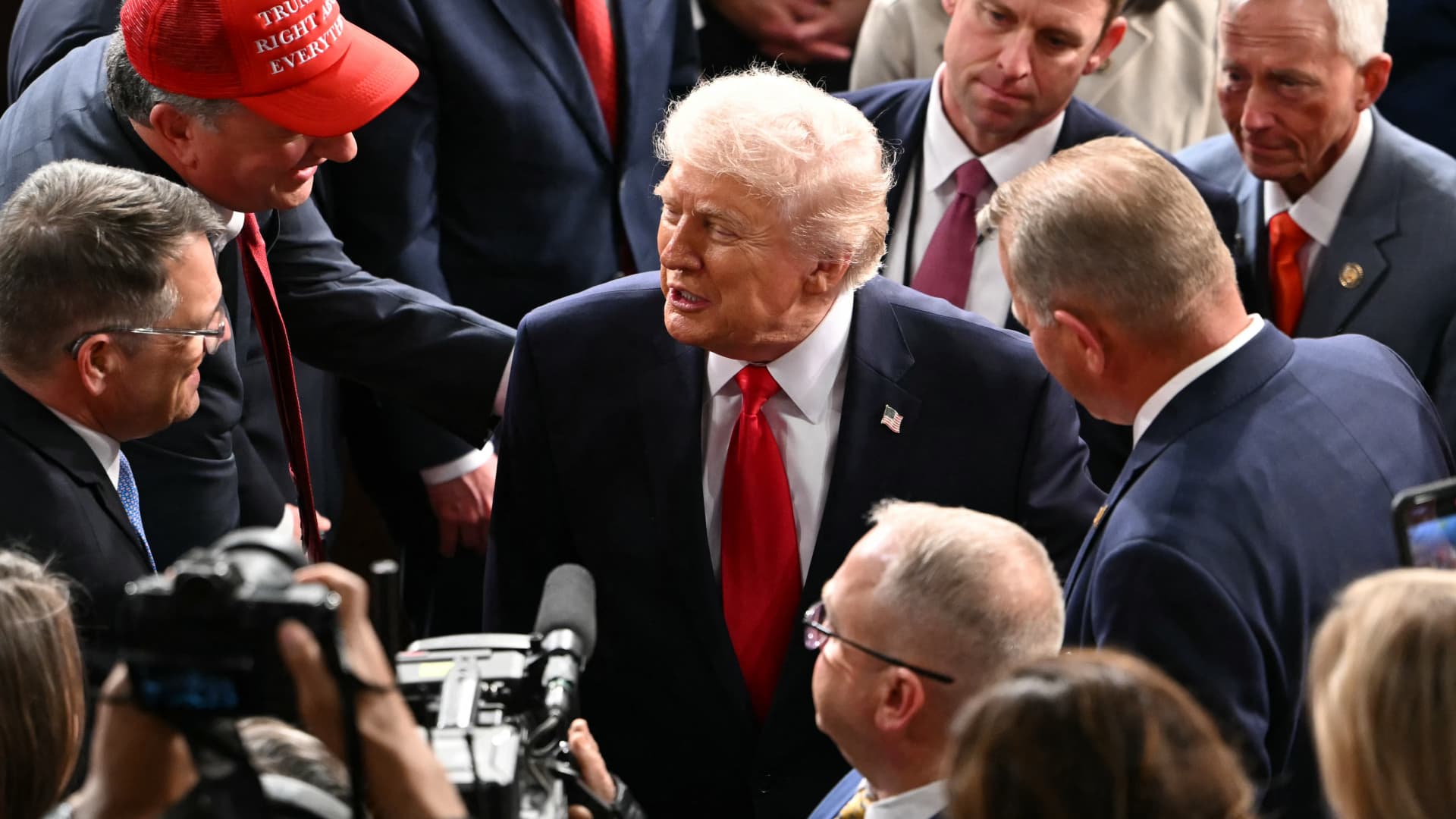
U.S. President Donald Trump shakes hands with members of Congress as he departs following his State of the Union address in the House Chamber of the US Capitol in Washington, DC, on Feb. 24, 2026.
Andrew Caballero-Reynolds | AFP | Getty Images
BEIJING — U.S. President Donald Trump avoided directly naming China in his State of the Union address Tuesday, just weeks before his scheduled trip to Beijing.
In what was the longest State of the Union (SOTU) speech by any U.S. president, Trump covered a range of topics from inflation and tariffs to stock market records.
But notably, he did not directly mention China, other than a reference to “Russian and Chinese military technology” that guarded Venezuelan President Nicolas Maduro during the operation that led to the capture of the foreign leader.
During Trump’s first term from 2017 to 2021, he made direct references to the Chinese nation in all three of his State of the Union addresses. The remarks had largely highlighted the threat from Beijing to the U.S.
“Trump doesn’t want to pick a fight with China in an election year,” said Gabriel Wildau, managing director, Teneo, referring to the coming U.S. midterm elections in November.
“Stability in U.S.-China relations is a priority for the president at least this year and potentially for the rest of his term,” Wildau said.
In order to maintain that relationship, Trump plans to visit Beijing from March 31 to April 2, the first trip by a U.S. president since 2017.
But China’s foreign ministry has yet to confirm exact dates for the visit, pointed out George Chen, partner at The Asia Group. “That makes Trump look more desperate to visit China more than how much [Chinese president Xi Jinping] wants to host him.”
“The lack of mentions about China in Trump’s speech is another example to show how Trump stays cautious now about U.S.-China relations,” Chen said.

China and the U.S. ratcheted up tariffs on each others’ goods last spring to well over 100%, before reaching a trade truce in October to bring tariffs below 50% for the next year. Beijing also tightened its restrictions on rare earths exports worldwide. The Asian country dominates the global supply chain for rare earths, critical minerals used in a swath of technologies.
“The state of the union showed Trump thinks glorifying U.S. military triumphs over weak states like Venezuela makes better election year politics than fighting with China over rare earths,” Wildau said.
Uncertainty around tariffs picked up over the weekend after the U.S. Supreme Court last week struck down tariffs that Trump had imposed on a swath of countries last year. Trump then quickly pointed to an alternative basis for raising the global tariff rate.
In social media posts on Weibo, two Chinese state media outlets highlighted opposition within Congress to Trump’s speech. Local attention in China to Trump’s address was otherwise muted.
Trump’s limited mention of China also reflects how unpredictable his policy on Beijing can be, said Yue Su, principal economist at the Economist Intelligence Unit (EIU).
“By contrast, [Democrat U.S. President Joe] Biden consistently referred to China in his speeches, which underscored a degree of continuity and predictability in his China policy,” she said, referring to Trump’s predecessor.
The Democratic Party’s rebuttal to Trump’s State of the Union Tuesday focused directly on Beijing.
“But as the president spoke of his perceived successes tonight, he continues to cede economic power and technological strength to Russia, bow down to China, bow down to a Russian dictator and make plans for war with Iran,” said Virginia Governor Abigail Spanberger, who gave the rebuttal.
A big deal coming?
For a U.S. president who has called out Xi by name in public speeches, the absence of mentioning the world’s second-largest economy in the SOTU speech marks a strategic move.
If Trump seals a deal during his Beijing trip, “he could easily frame it as a major achievement for his base,” said EIU’s Su. “And if negotiations do not go well, a retaliatory or hardline approach could be presented in a similarly positive light domestically.”

Subscribe now
Steven Okun, founder and CEO of Singapore-based APAC Advisors, said that this year, the speech was understandably more focused on topics that impact the midterm elections, which don’t include China.
But he pointed out that if Trump really wanted to address U.S. consumer affordability, lowering tariffs on China would “show up much quicker in people’s pocketbooks.”
“So, we may see a deal on tariffs with China end of March or early April,” Okun said Wednesday on CNBC’s “Access Middle East.”
Many U.S. company executives are expected to accompany Trump on his trip to China in a few weeks. Meetings with Chinese counterparts can be an opportunity to support deals, including Chinese purchases of U.S. agricultural products.
When asked about Trump’s limited discussion of China, Marko Papic, a chief strategist at global investment research firm BCA Research, simply said: “A big deal is coming!”
—CNBC’s Sydney Goh contributed to this report.